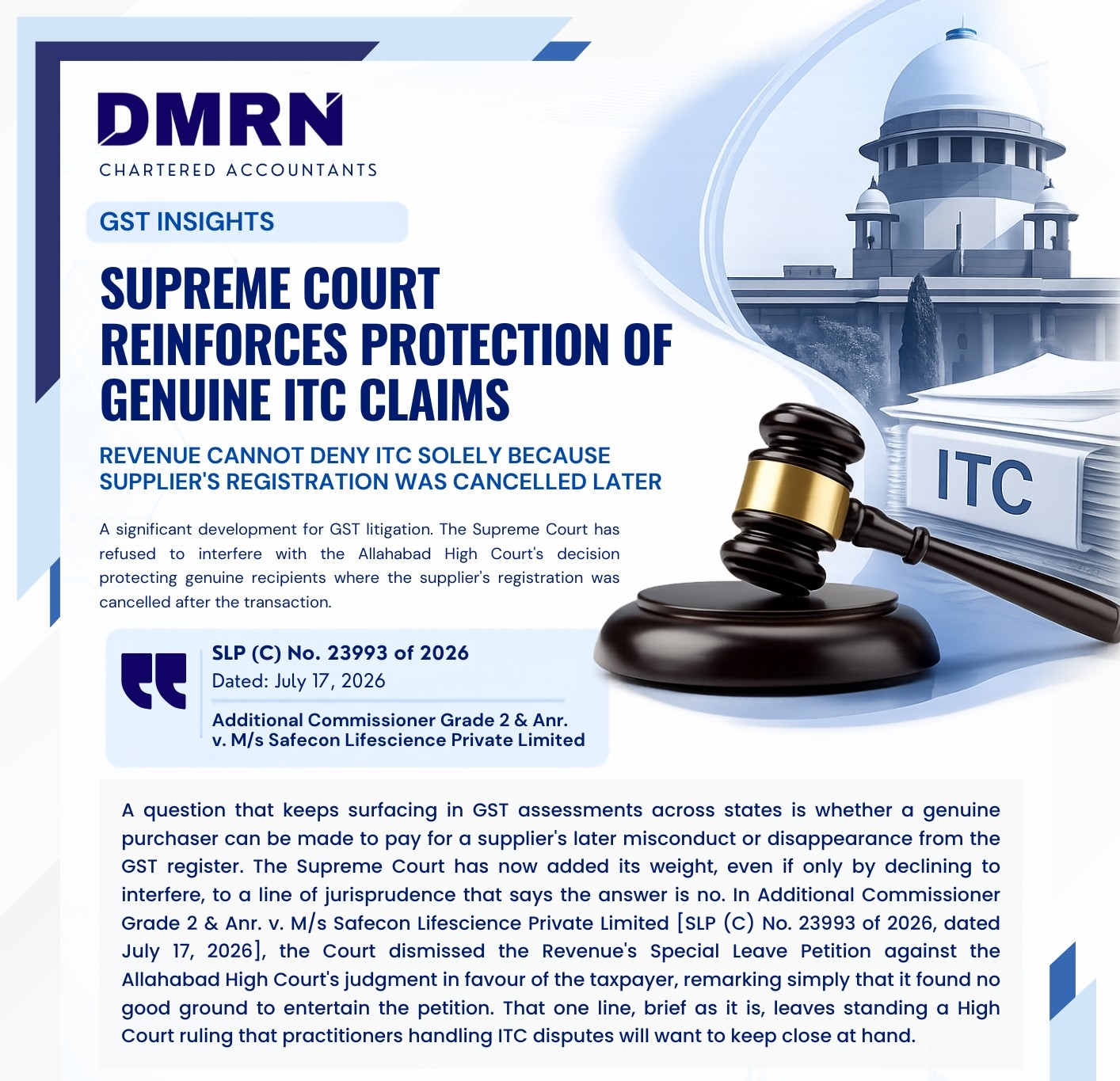
A question that keeps surfacing in GST assessments across states is whether a genuine purchaser can be made to pay for a supplier's later misconduct or disappearance from the GST register. The Supreme Court has now added its weight, even if only by declining to interfere, to a line of jurisprudence that says the answer is no. In Additional Commissioner Grade 2 & Anr. v. M/s Safecon Lifescience Private Limited [SLP (C) No. 23993 of 2026, dated July 17, 2026], the Court dismissed the Revenue's Special Leave Petition against the Allahabad High Court's judgment in favour of the taxpayer, remarking simply that it found no good ground to entertain the petition. That one line, brief as it is, leaves standing a High Court ruling that practitioners handling ITC disputes will want to keep close at hand.
The facts are familiar to anyone who has defended a client against a Section 74 notice built on a supplier's downfall. Safecon Lifescience, a pharma trader, had purchased medicines from a supplier in Bhiwandi during April 2021. At the time of the transaction the supplier was validly registered and held a drug licence, the invoice was backed by an e-way bill and a transporter's bilty, and payment moved through banking channels. The supplier had also filed its GSTR-1 and GSTR-3B on time and paid tax on its own turnover. None of that mattered to the department. Acting on intelligence received from the Central Excise and Central Tax authorities in Vadodara, the Agra GST officers issued a Section 74 notice years later, asserting that the supplier's registration had since been cancelled and that Safecon could not claim credit until the supplier had actually deposited the tax it collected, invoking Section 16(2)(c). When that did not stick on its own, the appellate authority found a fresh ground: the supplier itself had, a month earlier, bought goods from firms that had not paid tax, so the supplier's own credit was tainted, and that taint was passed down to Safecon.
The Allahabad High Court was unimpressed with either theory. It held that once the recipient has placed on record the invoice, e-way bill, transport document, banking proof of payment, and matching GSTR-3B entries on both sides, and none of that material has been disproved or rebutted, proceedings under Section 74 cannot survive. The Court was equally critical of the manner in which the Vadodara intelligence input was used. It had been acted upon without verification and without ever being shown to the taxpayer, which the Court described, not gently, as an order passed with closed eyes. Most importantly for practice purposes, the Court reiterated that Section 74 is available only where fraud, wilful misstatement, or suppression of facts to evade tax can actually be shown against the noticee, drawing on CBIC's Instruction No. 05/2023-GST of December 13, 2023 and on the Court's own earlier decision in Khurja Scrap Trading Company. No such finding had been recorded against Safecon at any stage, and an incorrect statement is not the same thing as a wilful one, a distinction the Court traced back to the Supreme Court's excise-law ruling in Continental Foundation Joint Venture Holding.
This is not an isolated result. The Delhi High Court reached much the same place in On Quest Merchandising, reading down the Delhi VAT provision to protect a purchaser who had actually paid tax to its seller, and the Revenue's SLP against that judgment was also dismissed. The Calcutta High Court in Suncraft Energy went further, holding that credit cannot be reversed from a recipient's hands without the department first making inquiries against the defaulting supplier, a position the Supreme Court again declined to disturb on SLP. Gargo Traders and LGW Industries from the same High Court, along with the Allahabad High Court's own decisions in Solvi Enterprises and R.T. Infotech, all rest on the same logic: what matters is the supplier's status at the time of the transaction, not what happens to its registration afterwards. Taken together, this is now a fairly settled body of persuasive authority, and the Safecon dismissal adds to it rather than standing alone.
A word of caution is still due, because this line of cases can be misread as a blanket shield. In Ecom Gill Coffee Trading, decided under the Karnataka VAT Act, the Supreme Court placed the burden of proving genuineness and actual movement of goods squarely on the purchasing dealer, and held that invoices and banking proof alone will not discharge that burden. Safecon survives scrutiny precisely because the taxpayer went well beyond that minimum, with e-way bills, transport documents, and reconciled returns on both sides, none of which the department managed to rebut. That is the standard a client needs to be held to when advising on documentation, not the lower bar that a superficial reading of the Allahabad judgment might suggest.
There is also a technical point worth flagging for anyone citing this order in submissions. A Special Leave Petition dismissed in limine, without a reasoned order, does not amount to a declaration of law under Article 141 of the Constitution, and the doctrine of merger does not apply, as the Supreme Court itself clarified in Kunhayammed v. State of Kerala. So the operative precedent here is the Allahabad High Court's reasoning, not a fresh pronouncement from the Supreme Court. That said, with the Revenue's challenge now off the table, the High Court's view stands undisturbed between the parties and carries real persuasive value in every similar dispute across the country. It is also worth noting, separately, that fraud-based proceedings under Section 74 will apply only up to FY 2023-24; from FY 2024-25 onward, Section 74A brings a common limitation period regardless of intent, though the fraud, wilful misstatement, and suppression ingredients remain relevant when it comes to the quantum of penalty.
For practitioners, the practical lesson has not really changed, but this ruling sharpens it. A recipient who can produce a complete documentary trail, tax invoice, e-way bill, transport record, banking payment, and a return that reconciles with the supplier's own filing, has a genuinely strong case against a Section 16(2)(c) or Section 74 demand built solely on the supplier's later fall from grace. Equally, when unverified intelligence inputs form the basis of a notice, the department is now on fairly firm notice that it must verify that material and disclose it before relying on it. The burden the department must discharge, and the one the taxpayer must discharge, are both a little clearer after Safecon than they were before it.
Leave a comment
Your email will not be published. Comments appear after review.
Comments
0No published comments yet. Be the first to join the discussion.